

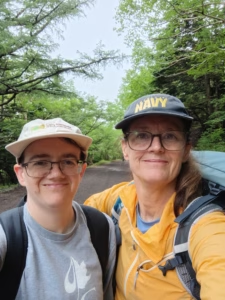
 We climbed Mount Fuji. For weeks now I have been feeling anxious because of the Fuji trip. I knew it would be demanding and I also knew I hadn’t done the hiking practice I was supposed to. But your biggest challenges are always the ones you don’t anticipate and on this trip the biggest challenge was not something I saw coming.
The Chronological Approach:
We started out on a bus from Shinjuku Station. The ride to the mountain is two and a half hours from Tokyo and involves some pretty scenery, some farms, some forests, some bridges and rivers. When we arrived at Fujikawaguchiko, we were in a beautiful green and red brown forest that looked like a poster. Or like the woods in Princess Mononoke. We arrived at Fuji 5th Station, disembarked, looked over our things, we had a cup of coffee, or at least I did, and we got ready to set out.
Mount Fuji Trailhead
We were at the gate to the trail. Some background: climbing Mount Fuji generally starts at what’s called the fifth station. There are nine stations going up the mountain. The first station I assume I assume is at the bottom. If this sounds just a little bit like the different camps going up Mount Everest it’s because it is the same principle. The stations provide support and supplies to climbers as they ascend. There are rescue workers on the mountain to provide assistance. There are also hospitality workers at the before-mentioned mountain huts. You book ahead to sleep at a mountain hut, and there there you can stay overnight, get dinner, and sleep a little bit before making the final ascent. The hike from the 5th station to the sixth station is mostly flat and when you reach the sixth station, they give you a paper map. Now you are actually beginning.
Something I Did Not Know
One thing I did not know which I should have known is that much of this hike is actually a scramble. There are lava flows and some of the route is to climb up them. This involves using your hands. If I had to guess I would say of the four miles you travel straight up the mountain, perhaps as much as half a mile is more a scramble than hike. So we left the sixth station and began to go up. Hiking up switchbacks gave way to crossing our first lava flow. I leaned down and put my hands on the rocks. I felt very scared. I had figured I could probably make this hike from the standpoint of physical demands, but here I was going to have to climb a little bit.
And Something I Forgot About
Above the seventh station the climbing became a little more intense. You had to really watch. And here the mountain began to get steep. And we faced a problem I hadn’t anticipated. My fear of heights.
I Begin to Question:
How much more of the scrambling was I going to have to go up? And how steep was it going to get before we got to the top? We had reached the point of what I’ve introduced earlier as exposure. That is the risk of falling. At its worst, the hiking term “exposure” means cliffs. Climbing Mt. Fuji we faced something which I would not call cliffs, however there were plenty of places where I think you could roll down the mountain if things went badly wrong. There were ropes hanging beside the trail not so much to keep you on the trail if you slipped I suppose as to keep you in an area where you would not actually roll down the mountain if you fell. If this makes sense, they were keeping us in an area where catastrophic fall would not happen. However, there was still the very real danger of breaking your leg or God knows what, and they had told us to wear helmets which we had not done. And many of the steps were foot high and a number of them were 18 inches high. When you weren’t scrambling. I suppose they built the steps for areas that were simply too hard to cross.
Once It Was a Shrine
Sue told me that long ago Fuji was only climbed by religious devotees and it was a shrine. Unfortunately before the route was improved, people did die on this mountain because the unimproved route had severely dangerous spots (exposure again, remember?). People still do die on this mountain, actually. Mostly as I have heard because they did not follow the rules or “hiked” outside of the permissible season. That was some, but not a lot, of comfort as I was scrambling up the slope.
This is not a Walk Up, People
As it really was, I understood now so much better the tone of the materials I received, many of which sought to explain to hikers who had never seen Fuji that it was not some casual hike or as we call it in hiking group, “a walk up.”
Looking at Fuji on a Difficulty Scale
Fuji would be a 2.5 D according to a scale published on Kanto Adventures website (https://www.kantoadventures.com/hiking-difficulty-scale.html). Which means some danger of falling, some danger of severe injury, more than a thousand meters of elevation gain, and a long distance. The reasons the hike takes more than one day for most. To put in another simple description: in Colorado we usually hike on hikes that are beginner, intermediate, or difficult. But Fuji would be rated a level up from all those as challenging. And we were climbing. Really we were mountain climbing at times. It had stopped being hiking and was the simplest type of bouldering.
Seventh Station
At the seventh station the mountain hut we encountered was bolted into the cliff and when you walked across the front porch, you could feel that there was nothing under. It was a kind of hammock on the side of a mountain. I was getting freaked out. The thought “I am too old for this” did occur but I crushed it back down. This is not the time for that, I thought. I could go back down, but then I would have to climb back down and as you may be aware climbing down is generally harder. The descent is often the time when things go wrong.
The Only Thing to Do is Go Up
We continued going up. At one point, crossing a lava flow and having made the mistake of looking down and seeing the mountain slope yawning below me at a steep angle, I assessed that it was very very scary and I looked up and saw the next hut 100 yards away and it seemed to be hanging there almost above my head. This was a very steep trail. If it could even be called a trail. I realized I would have to do more such climbing before we got to our beds and beyond that, after a brief sleep we would finish the mountain with more of the same. I cried. I didn’t know what to do, despair hit me and I was stuck! I could go down but that seemed worse than going up and going up seemed impossible. Sue was worried, she expressed sympathy, but I knew that for such problems we only can rely on ourselves. There are times when we can only pray. And I did!
We Do the Best We Can
I remembered the fortune I got at Meiji Jingu, the small poem by Empress Shoken which said “A single thread when not taken properly from the very end becomes all tangled…” and I considered that, given this fortune, I needed to do everything just right on this climb. Along those lines, I considered all the people that were climbing with us, and realized that if one were careful, and I would certainly be, it would be all right, I would make it. We all would. Therefore I would go slowly and carefully but I would go forward. Another thought came to me. “The person who says they can do something and the person who says they can’t, are usually right.” I dried my tears. I said “I can” and I kept climbing.
Acceptance of Risk and Reality
You get to a point where you have to accept whatever happens, you have to accept the worst possible, and then you have to try to do your best so that doesn’t occur. When we checked into our hut, the Taishikan, the host looked down a list of names on a hand held screen and found Sue and admitted us. The other hikers who were not staying were not allowed inside the hut proper. We took off our boots and we rested. I was very grateful to see that this hut was built on a ledge. We were shown to our booths and sleeping mats and I lay down and I felt as if my head was lower than my feet and that I would slide off the ledge and that the whole hut would slide off the mountain. I wouldn’t even be able to see it happen because there were no windows in the sleeping area! Then I told myself to stop it. It was the same as when you’re on an airplane; you don’t have control over anything anymore. All the people I was climbing with had accepted these risks. And believe me there were hundreds. Our hut had perhaps 50 people staying overnight and there were at least a dozen huts on the mountain.
What is a Mountain Hut Anyway?
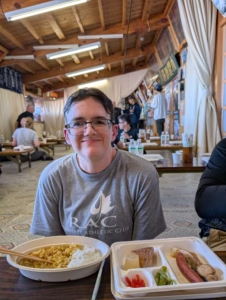 “Hut” is a good word for it. There is a large room, maybe 40 feet by 20, where they serve dinner and sell a few snacks, coffees and tea and water. There is a sliding plate glass window that faces out from the mountain. There is a desk for vending to hikers as they go past, with a small window like in a snack bar. The back of the hut is dug into the mountain. Outside is a balcony maybe 6 ft wide and as the hikers climb, they pass along this balcony before continuing on the next stretch of trail. On the balcony, there are benches so you can rest. Each hut, then, is a pass-through point. There’s a toilet shed outside with a special type of toilet which flushes somewhat like the ones on an airplane. To flush you squirt water from a spray gun. This is how they save water on the mountainside. The toilet is available to hikers and staying guests.
Who Was Hiking Fuji?
And who was hiking? Mostly Japanese, of course, although it seemed there were more Germans then you would expect and more Americans than we saw in, say, Meiji Jingu. There were a few families with teenagers I saw but mostly, it’s true, young men dominated the group and older men were many. I was not the only woman of a certain age who was climbing Mount Fuji. Although all the other older women I saw were Japanese. I saw a couple of 40-something women from India and we encouraged each other. I saw a tiny young woman in a bright pink parka (which I admired) with her boyfriend, a very sturdy and calm young man, struggling up the hill. She was unsmiling but determined. I felt sure she felt about as I did, that this mountain climbing was a lot. In that moment I could see her with her children, telling them that this is the way we do things. Somehow I was sure she would do well in her next phase of life.
We Start For the Summit
We went to sleep quite early, after a nice vegetable curry dinner was served at around 4:15. We were both asleep by 6:00 p.m. I had told Sue there was no way I was climbing the rest of the mountain in the dark as people do, leaving the hut at midnight or one or two and then climbing up to the summit with headlamps so you can see the sunrise at 4:30. But in the middle of the night I heard the people leaving the hut. I had woken up and I thought about it. What was the point of putting off our ascent? When in Rome we do as the Romans do, and these Japanese hikers had determined that the best way was to leave now and reach the summit at dawn! Knowing that we had brought our headlamps, I woke Sue up and said “Let’s go.” She had told me that the final ascent was not as much scrambling as the part below our hut, that in fact there was only about 100 meters above the Taishikan hut that I would describe as true scrambling and the headlamp was adequate for its job of showing the next step or handhold. I do have to admit that only a couple of times I thought about the darkness beyond the light of the lamp and whether in fact a cliff was out there, but staying in the moment, there was not much time to concentrate on such fears. The next right thing was my job.
Climbing in the Dark
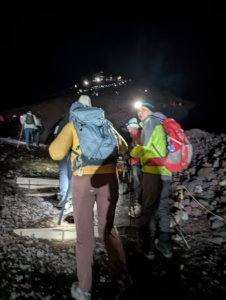 We had a long way to go. We had spent 4 hours getting to the hut the day previous and the host at our hut had told us that if it took us 4 hours to get that far, it would take us another 4 hours to get to the summit, and then another 4 hours to walk to the bottom. Climbing at night up the side of Mount Fuji, in the dark, I used all the gear I had bought to keep warm. We reached the next hut up and I stopped to put on my long underwear under my hiking pants. I also added a second foundation layer that was heavier than my regular technical shirt. I wore my gloves. I zipped up the neck of my polar tech. Sue for her part also was wearing all her warm weather gear also. We had been told the temperature was hovering around 40°. Which in the dark is cold enough. The wind was 15 km per hour, and you could really feel it as you rounded the right-side switchbacks.
One Hut at a Time
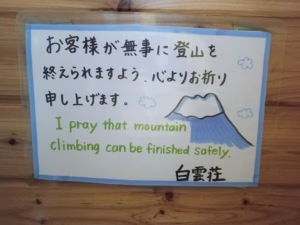
We came to the next hut in the line above ours and I asked if they had hot tea. (Yes they were open for business at 2 a.m.) The attendant reached in and said yes and pulled a can out. It had been in some kind of heater and it was warm. I drank it. At the next hut I went to use the bathroom and found the small poster pictured below inside the stall. I thought I am not alone, someone else understands exactly how I feel. And we continued in the dark. It was at that time about 3:00 a.m.
The 9th Station
We reached the 9th station and the roof had caved in some time previous, it had been abandoned and had the aura of a modern ruin. The night was still dark and I stopped to rest. We were making good time. Keeping up with the line of hikers. Turning up towards the summit now, it was mostly switchbacks.
Low Oxygen Up Here
But there were so many switchbacks. I moved my feet just tiny amounts, one foot lifted and went ahead the length of a single foot, and then the next foot went the next length. We were going very slowly and so was everybody else. The elevation gain on the section that we hiked that night was 2,400 ft. Over the space of 2 miles. Those who hike know that that is an unbelievable altitude gain. Yet we continued, one little step at a time, and slowly. People stopped by the side of the trail and rested, you could hear them breathing. I saw people take bottled oxygen out. Fortunately, since I live in Fort Collins, (5100 feet elevation) I had no real altitude sickness symptoms, and Sue was the same. She was, relative to her ability, taking it easy so to speak, so her risk of altitude sickness was less for that.
A Golden Line on the Horizon
Now there was a grayness in the air that I noticed and far away a gold line appeared on the eastern horizon. Sometime after that, I realized it was no longer necessary to use the headlamps. It was 4:00 a.m. and dawn was imminent. Twenty or so minutes after that, people began to stand or sit on the trail and watch the gold line in the eastern sky which stood above a white sea of clouds. The line became brighter, it became wider. It became orange at the edge.
A Cry Goes Up
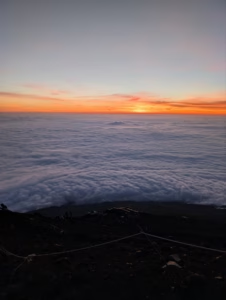 And then a cry went up as the first dot of sun rose above the dark line of the horizon. The sun had emerged, the sun which of course is a symbol of Japan. It might be strange to us to think about Japan as the land of the rising sun because we live in North America, and for us Japan is situated squarely in the land of the setting sun. But of course, they are residents of what in the old days was called the east, the occident, more properly Asia, and Japan’s geographic world is Korea and China and through Singapore and into India. And of all the East, when day begins, Japan is the first place that the sun’s light will strike.
Sunrise on Fuji
Fuji, the tallest spot in Japan, is the first place in Japan the rising sun will shine. Here we were. It was a solemn and profound moment. The sun rose further and it became a bright burning dot on the horizon, shining above the cloud cover so far below, shining into the sky until finally the whole world was light and I thought about how a tiny thing like a burning dot on the horizon becomes huge. We take this for granted, that everything works as it should and only when we slow down and really look at things, only when things are taken away or threatened, do we think about the miracles that we live with. Such as the orbiting Earth and the fact that at each place on that Earth the sun rises and that we keep breathing.
We Reach the Summit
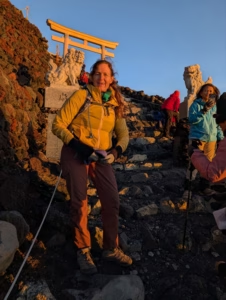
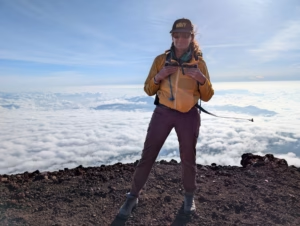 We had not yet reached the summit. There was still more climbing to do, one short step after another, but at about 5:00 we reached the Torii gate and the two shisa type dogs at the entry to the sacred summit of Mount Fuji. We took a picture then joined a rush of travelers, clad in mountaineering gear, who stood looking over the world from the balcony in front of the final hut. The view was simply clouds and they were far below. The sun had begun its journey up, and the sky was now turning blue. The caldera of the volcano was behind the hut and a strip of snow let down into its bottom. Workers were stamping Fuji walking sticks with the final summit stamp and a small souvenir stand was there where I bought three postcards. Certainly there was a crush of people.
And We Started Down
The lure of rest, taking the boots off, and a bath was real. So as quickly as all that, we started down again. The road down is the access road for all the huts. Workers on the route drive in small half-track type trucks. It is quite steep, and the footing is loose, consisting of volcanic grit too big to be called sand but not so big that you can’t slip in it (called scoria). The switchbacks are so numerous they cannot be counted without really paying attention – I would guess there are 30 or 40. We went down slowly because there was a real danger of sliding and falling on your bottom. I saw a number of people do this. I myself slipped but caught myself on my hand, suspended in the yoga pose of side plank. “I did not actually fall,” I told Sue. “My knees never hit the ground.” It was important to me that I not fall, even in this small way somehow. And we went down.
Even the Descent Was Not Easy
The descent was not easy even though compared to the ascent it had to be. We were somewhat impeded in our descent speed by the fact that we had not brought hiking poles. These hiking poles are very popular these days but I have never used them. I never felt I needed them! But here was an instance when I needed them and didn’t have them. People with hiking poles were able to go faster, were able to protect their knees and were able to catch themselves if they began to slip.
I Review my Gear
So I wish I’d bought the poles. However. One thing I did learn on this trip is that my Deuter backpack is really excellent. Able to hold all the materials I needed, comfortable so that I never noticed I was wearing it, and with easy access to the main compartment through a front zip so I could get my gloves, hat, etc. when I needed to change gear. It has a holder where you put your hiking poles once they are telescoped into the smallest size. And we descended, shedding the warmth related gear as we went. My skiing base layer, my gloves, my polartec. Sue called me a “gear head” because I had so much specific gear for various temperatures, etc. and a clear practice for storing and finding them. She, for her part, had simpler equipment and relied on her Marine hardiness. (She and her friends had run down the hill the previous time she climbed Fuji. Marine-style, they went fast and furious. She did tell me that the day after she had DOMS (Delayed Onset Muscle Soreness). I’m only a little surprised. Of course today as I write this I myself have DOMS.
And in Conclusion
The descent was in its own way demanding but finally we reached the sixth station where the horses were. From then on the journey was largely flat and the difficult footing of volcanic pieces ended. We were greeted with congratulations by the gatekeepers as we reentered the fifth station. Like hikers and climbers everywhere, we looked around, and as quickly as possible we went to a lunch counter and had a meal. In our case, this time it was breakfast and lunch together. Sue purchased bus tickets back to the city online. We both felt very tired but very accomplished and yes I bought a t-shirt. On the bus home I reflected that this was a lifetime achievement. I didn’t know if I would ever do it again but I didn’t have to. I had seen the sun rising over the Pacific and making Asia landfall first near the summit of Mount Fuji. And I had ended the project safely. The feeling of relief was overwhelming. I survived the Fuji climb.
Japan Trip Series of Blog Posts:
Day 1: Leaving on a Japan Trip
Day 2: At 32,000 Feet, Flying to Japan
Day 3: A Perfect Day in Naha, Okinawa
Day 4: Walking Around Okinawa
Day 5: Visiting Yomitan Pottery Village
Day 6: Tokyo is Fabulous
Day 7: Shopping Day in Tokyo
Day 8: We Climbed Mount Fuji
Day 9: Last Day in Japan


