

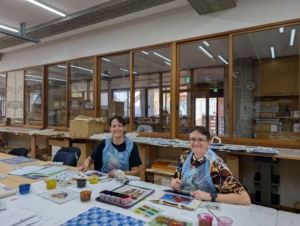
 It is a perfect day in Naha, Okinawa. We are doing a workshop in Bingata printing. The workshop is at the Shuri Dyeing and Weaving Museum Suikara. The museum is on a hilly street, and we sit in a textile classroom with high ceilings and windows, watching the textiles teacher get out the painting materials – canvas tote bags and natural dye based paints – and speaking to us about the process of bingata. This is an opportunity we discovered through my guidebook, followed by an internet search. The idea that a tourist can sit down for an hour and a half and be taught local art and folk culture by a real artist is, I think, amazing. Just like the AirBnB Experience choices, if you’ve seen that. We are making canvas book bags painted with local designs. The design is already stenciled on the bag, and we will paint the colors and then wash off the stencil in three days. I chose to make a picture of a bowl of soba noodle soup like the one which I had for lunch, while Sue is making a shisu dog. The women who are teaching us are serious, dedicated, and highly competent. The younger one speaks limited English, however, with Google Translate, she can type in a sentence into her phone in Kanji (the word-character system that Japanese adopted from China in the 6th century AD) and we can read the translation. Additionally, instruction sheets have been prepared in English to explain the process. The second teacher, an elder, who is also teaching a group of three Japanese-speaking women working on a different dying process, is more fluent in English. She has steel-gray, short curly hair, wide set eyes, and the air of command of the captain of a ship. She keeps an eye for error intervention in all the students. She gets up, looks over at me, indicates my work, and says “dry first,” and gives me a hairdryer. I had neglected to do the steps correctly and the colors on my bag have somewhat run together.
Mistakes Make us Human, Right?
I keep going. I tell Sue that my mother says, “if it doesn’t have any mistakes, how do you know it’s handmade?” The paints are in small glass jars marked with katakana script, a phonetic group of symbols used exclusively for foreign words such as “coffee.” Sue says learning the script is quite difficult, though she is working on it and can sound out words from signage.
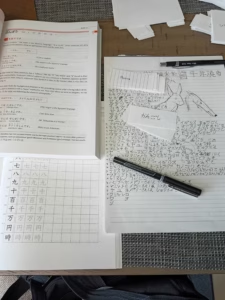
As for reading Japanese, either katakana, or hirogana, which is similar but more roundedly shaped and used for Japanese words, or Kanji, I am at a loss. Someone said there is a lot of English signage in Japan, but it does not seem that way to me. Before coming here, I did not realize how much of my daily life is “reading the room,” especially when travelling. If words use Latin letters, I can at least sound them out. But with characters, I’m lost. I might as well be blind when it comes to reading Japanese. I can’t even tell the first sound. Sue shows me the Kanji for “Okinawa” and I might be able to recognize that. Maybe not. Sue’s bingata dying is more successful than mine. She is painting a tiled roof bearing a shisa dog and she’s changed the color of the dog from yellow to blue. The young teacher looks at Sue’s work and says “kawai.” I feel proud of Sue, after all, she’s my daughter. But I can’t tell the teachers this, I don’t have enough Japanese. Perhaps they can guess.
My Japanese Vocabulary so Far:
I have used these spoken words: “Domo arrogato zaimasu:” Thank you very much. “Hai:” yes “Kado:” (credit) card and now, “Kawai:” which my daughter Jo taught me years ago. “Cute.”
All Roads Lead to the Mall, Including on our Day in Okinawa
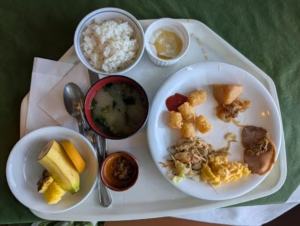
Speaking of Kados, in addition to successfully completing the painting workshop and now carrying our painted book bags home, we went on a shopping spree. I spent, according to my rendering of the receipts from 10 shops that we visited, Yen 48,842, and in addition, $23.35 at the Camp Foster Commissary. But don’t worry too much. That’s only $316.40 in dollars. 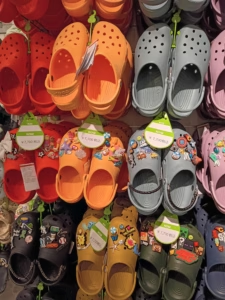 I suppose I could ascribe it to jet lag. We had breakfast at the lovely dining room at my hotel, the EM Wellness Retreat Okinawa. This hotel is based on healthy living practices such as Effective Microorganisms (the EM) which are used to support health through fermented food products and cleaning products. This sounds a little unusual and perhaps it is, but my internet research suggests that this is not a one-off, there are “1.2 thousand” of these EM Wellness hotels worldwide. The special thing I have experienced here is the breakfast. There is a huge smorgasbord of items which range from fresh tofu with sauce to eggs from organic chickens raised in the EM Wellness hotel farm, vegetable stir-fry with pork, fruit, yogurt with honey, rice … even sausage. Coffee, tea, and dragonfruit smoothies. Then there’s local juices. All you can drink. Ah, the relaxation of being in a room with so many food choices … I don’t think I overate, however, I took small portions! With no bread products and almost no milk, I think it was pretty healthy. Calorie counting was skipped, however, I’m on vacation. Juice is big here and I chose one for myself while on a trip to the mall.
  I bought myself a new dress at the Kahiko Hawaii shop, and stuffies for the grandkids at the Pokemon Shop. We went to see Shuri Castle in Naha, and walked around in some pretty serious tropical sun, up and down the reconstructed grounds of the castle, where you could see on one side the taxation and bureaucratic offices, and on the other side the office of the ministers and ceremonies. Kind of like the two houses of Congress?
 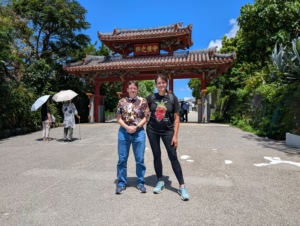 Above all, a massive, two yard long dragon head looked down at us, his mouth open, his teeth showing, his long whiskers waving in the air. We walked to a hilltop vantage point, looked over the town, the high school, junior high school, the sea, the radio tower … and then down to a pond below the walls, where a shrine was built on an island to honor a local kami (sacred power, divine being, or spirit according to Shinto religion). A sign there said “Remove your shoes in this sacred spot” and I looked at the cement and the wood floor of the shrine and wasn’t sure where you were supposed to take off your shoes so I left. We went to lunch at Sue’s favorite soba spot, Maruchi, full of locals, and we did take our shoes off there. You also sit on the floor. A helpful parking lot attendant helped us get the car (a Daihatsu which is about 8 feet long in total; engine size: motorcycle) into a tiny spot. The attendant was wearing a black jacket with a fan where the hip pocket usually is, and the fan was whirring. An air conditioned coat. When we walked around later, I saw more of these. The ratio of men working on various construction and repair projects to people walking – and there were plenty of people walking – was about 2 to one. Out on the streets, Sue’s car is the right size and most of the vehicles are the same. The streets are quite narrow. When you see a Honda Civic, you’re like “What the hell is your problem, Mac, driving that huge thing around here?” and the sight of a full size garbage truck (many trucks are small vans, including the garbage trucks, but I saw one mungo garbage truck yesterday, driving next to us) is terrifying.) In the words of Mr. Miyagi, an Okinawan character from The Karate Kid, (get too close and) “you be squash, just like bug.” I got some weird looks from women and some weird looks from the workers and decided possibly yoga pants were not street appropriate. Yoga pants may not have arrived on Okinawa yet. Honestly, thinking about it, they may never. Many women, including young ones, wear dresses, or loose, stove pipe type pants. Tomorrow, I will wear a dress. For sure. A maxi dress. This is the year of the dress, 2026. More on that, later. More on foot, today.
Japan Trip Series of Blog Posts:
Day 1: Leaving on a Japan Trip
Day 2: At 32,000 Feet, Flying to Japan
Day 3: A Perfect Day in Naha, Okinawa
Day 4: Walking Around Okinawa
Day 5: Visiting Yomitan Pottery Village Day 6: Tokyo is Fabulous Day 7: Shopping Day in Tokyo Day 8: We Climbed Mount Fuji Day 9: Last Day in Japan


