

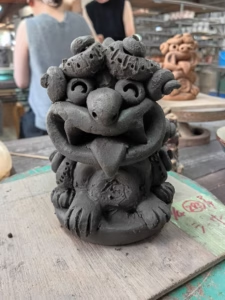
Our last day in Okinawa was shisa day. We were visiting Yomitan Pottery Village after breakfast to engage ourselves in another art class: the class in making a shisa. As noted above, the Okinawan shisa is a relative of the Chinese lion dog protector spirit. These shisas stand outside of doorways and on the roofs of houses all over Okinawa. There seems to be no other artifact which has been more deeply adopted or more widely displayed by the Okinawans, then the shisa.
Art Class Again
This morning, at our pottery class, Sue and I were instructed by a Young Japanese Potter, who step by step painstakingly taught us one method of building by hand a stonewear shisa. The Young Potter was able to speak some simple English sentences of simple type, and was interested to hear vocabulary such as the words cone and spindle for the shapes we had to create., She was probably about 20 years old and wore a heather gray t-shirt and a baseball cap with long straight hair. Leading by example, she made her shisa first and then each of us followed suit. Step by step using coils and balls of clay, we built our shisas from the pedestal up.
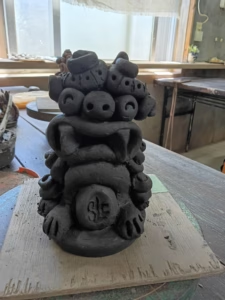
It was demanding, the clay prone to dry and crack and the process of joining the pieces together with clay slip (mud, really) has to be done carefully, lest the whole project explode in the kiln. Spinning the ends of the eyebrows was only moderately successful for me. But in the end we were able to finish our shisas. I created the female and Sue made the male. They were ready to sit on a table top to welcome friends and family alike.
Shopping the Pottery Village
Next we went to the pottery village proper and tried to remember where Sue had seen a pair of medium sized shisas that she wanted to buy.
We walked back and forth, going through five different shops and could not find the shisas. Were they already sold? Sue was a little concerned.
“Oh come on,” I replied. They were hundreds of dollars and I couldn’t believe that they’d sold two such works in one day.
Okasaan!
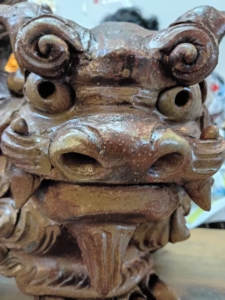
We went back to the original shop, and discovered that the shisas had been moved to a shelf outside the front door! Sue communicated her desire to purchase the lion dog with excited gestures and the shopkeepers responded with enthusiasm. The shisas were being wrapped up, carefully, and two cardboard boxes were brought. The sellers were pleased, I could see. It’s always good to make a sale. An older woman was helping a younger woman to do this work and she asked me “Okaasan?”
I didn’t understand. Sue said, “It means Mom. Don’t you remember in Ponyo, they were yelling “Okaasan, Okaasan?” Then she added, “The ‘san’ is an honorific.”
Ah. Yes. Okaasan. Pointing to myself. “Okaasan.”
The ladies smiled, put the shisas, wrapped in paper and bubble wrap, in the matching cardboard boxes, and Sue carried them to the tiny car.
“Kanojo wa tsuyoidesu” the older woman said, nodding to Sue. She made the flexing-the-muscles gesture of a bodybuilder. “She is strong.”
Sue appreciated this. We laughed, thanked them, and drove off to the beach.
We Hit the Beach at Zampa


It would have been embarrassing, perhaps, had we not visited an Okinawan beach on this trip and gone snorkeling. Okinawa is famous for beaches. I must admit our visit was cursory. However, we went in the water, we snorkeled, we saw wrasses and triggerfish and blue damselfish. We were at a busy, family friendly beach and saw many other beachgoers, including a group of 15 or so Rohingya speakers, with adult women wearing the same hijab and speaking some of the same phrases that we hear and see at our school in Greeley. The women waded into the water, the children played, the men snorkled. Just another happy family on this day in Japan.
But the Police Were Not So Happy
When we got out, we saw that the police were ticketing some people who had parked on a narrow road down by the beach. Fortunately we had parked in the public parking lot. Along the road, sugar cane, once an important cash crop here, grew freely. Sue was pleased she had avoided this situation, after the policeman asked us, “You! You parked here?”
“No.” And we thus escaped.
A small cafe, Maeda Breeze, seemed a good spot for lunch and I was amazed by the deliciousness of a roast beef sandwich with berry jam on a crusty fresh French baguette. The cafe was decorated with bicycle memorabilia. The proprietress, a pretty woman in a flowered shirt and black skirt who spoke English, seemed reasonably friendly so I asked her about the decor. Was she a bike rider?
Yes, but mostly her husband.
Did he enter the Tour of Okinawa that was featured in the poster?
She laughed. When he was younger!
Was that his white bike hanging over the small stage in the back?
No, that was a champion bicycle racer that won the race and that was his bicycle. It was an older one, maybe from the 80’s or 90’s.
We said “Domo arrogato zaimasu” (thank you very much) with great sincerity, since someone who feeds you when you come in from the beach is appreciated, and someone who feeds you unusually good food when you come in from the beach is appreciated most deeply. We bowed, she bowed.
And we left, our day finished except for resting.
Japan Trip Series of Blog Posts:
Day 1: Leaving on a Japan Trip
Day 2: At 32,000 Feet, Flying to Japan
Day 3: A Perfect Day in Naha, Okinawa
Day 4: Walking Around Okinawa
Day 5: Visiting Yomitan Pottery Village
Day 6: Tokyo is Fabulous
Day 7: Shopping Day in Tokyo
Day 8: We Climbed Mount Fuji
Day 9: Last Day in Japan


