

Tokyo is Fabulous. And we’re surrounded by it.
What a city should be, but never is in reality, that is my first impression of downtown Tokyo.
We Land in Tokyo
When we land in Tokyo we have no trouble getting our bags and decide to send them to our hotel using bag courier service, available at a counter across from baggage claim. This means the courier will take the bags to the hotel so we do not have to take them on the subway or watch them until 4:00 p.m. check in time.
We take the monorail into the city and then transfer to the green line to arrive at Harajuku station near the south entrance to Meiji Jingu shrine. Riding on the subway I realize it’s been half an hour since I’ve seen anyone who could be an ethnic European. Apparently people who look like me don’t take the train. The local populace of Tokyo, on the other hand, ride together on the subway.
The demeanor is quiet, focussed, forbearing. No twenty year old young man starts cutting up and shoves a friend. No girl laughs shrilly. People my age are quiet, composed, and they seem deep in thought. Some are on their phones, but there’s less of that than I would have expected. Some seem to be in a state of reverie or meditation.
Where are they going?
I look out the window and up at a 20 story apartment building, each apartment with a glass balcony. I realize that they are going to all these tiny apartments, perhaps as much as a million of them. Each apartment with their own things, each apartment with their own family.
In the US, in the suburbs, the concept of a freehold house, that is a home surrounded by a garden, where the owner has the title to the land, even though it is a 50×100 plot of land, is the definition of a middle class person perhaps. But in Tokyo, almost no one has a freehold house. How do these people get their need for time on the Earth met? I am to find out.
Clackety clack. We cross over a finger of the bay. We go thumpingly into a tunnel to cross under another inlet. Apartment houses, gleaming and then worn, pass us by.
When we get to our station, we climb up out of the subway into a truly crowded street. We have decided to visit Meiji Jingu, a garden and temple within the city, but first we must find lunch. We slip into the Tokyo sidewalk scene. Along with us there are hundreds of people coming up out of the subway.
First there is a row of trees, then there is sidewalk, then a row of shops, then there are lanes that lead back in between the buildings and there are more shops off of these. Planters in tiny gardens offer relief from the constructed world, and old houses are behind the new modern high-rises. Sue and I find a restaurant on the back corner of a high rise building that offers modern Japanese food. We are seated inside and then waiter comes up with a cell phone which he holds out. He is using Google to translate the information that the kitchen is very busy and we may have to wait longer than usual. We shrug. We’ll wait.
I ordered taco rice. It is good and I eat it all except for a little bit of rice I leave because a “real lady” does not scrape her plate. That is a voice from my childhood, from a book, not a person. How to be a lady. That was so long ago.
Meiji Jingu
This garden and Shinto shrine is dedicated to commemorating Emperor Meiji and his wife Empress Shoken. Shinto is the ancient animistic religion of Japan, which values harmony, a sincere heart, and divinity in “kami,” or divine spirit. Meiji, author of the Meiji restoration of 1868, was the beloved emperor of Japan who according to the brochures at the shrine, faced challenging conditions including opening Japan to the West and the end of the Tokugawa shogunate. Meiji said that from his time, Japan would adopt the best Western technology, ideas, and design but still maintain traditions and the unique identity of Japan. Thus he reversed the closed stance of previous leaders who separated Japan off from the West during the time of the shoguns.

This is an extreme simplification but not one I can expand on here.
Meiji Jingu was created after Meiji’s death and the death of Empress Shoken, who participated in Meiji’s work behind the scenes and promoted national welfare, women’s education, and was also concerned for world affairs, creating a perpetual fund to support the international Red Cross.
Meiji Jingu was created by volunteers in 1920. They planted trees and other plants and created the natural woodland-within-the-city as a sanctuary for humans … and animals.
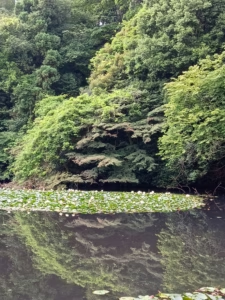 This magical forest is filled with visitors but it doesn’t matter, its huge trees arch over us and it is surreal and you feel solitude. We walk through iris gardens by the secret lake where the empress used to fish, and visit the secret well unearthed by Kiyomasa, feudal lord of the 16th century.
Through the whole walk a gentle rain falls but it does not matter, it seems some deity is holding us in his hand. We go to the shrine proper and perform ablutions before entering, washing our hands, rinse our mouths out and then wash our hands again, as instructions tell us to do, and enter the shrine.
The Shrine Proper
The four walls in the shrine surround a central courtyard and here people are milling. The practices one may perform are several: you can make a prayer board on a piece of wood for 500 yen and in the morning the monks will include your prayer intentions at devotions at the shrine. You can draw a fortune from a wooden box. The fortune is actually a small poem written by the emperor or his wife. And for a small donation of coins, you can approach the shrine itself, which is mostly hidden from view, and pay respect. To do this you bow, clap twice, and bow.
We pay respects at the shrine and we collect fortunes (mine has something to do with the difficulty of pulling out a single thread and rumpling the entire garment from which it came, which I take to mean be careful as you make changes) but we do not write prayer requests. I tell Sue I have prayed so much about my concerns that it hardly seems reasonable to think that putting them on a prayer board would intensify God’s concern.
The Prayers of Others
But we spend some time reading the displayed prayer boards of other people which, when they are finished, are hung on a hexagonal building. Most of the prayer requests are in Japanese but there are many in English and not a few in Spanish and these I read. We read many thanks for health and happiness, for good health, and for friends. Some prayer cards are turned backwards so you can’t read them, and I assume these are more personal. I do find a few that are more serious, one from a woman whose brother has cancer, and one from a young woman who wants her mother’s knee problem to heal so she can travel with her. I feel sympathy. How much we are the same.
“Bear each other’s burdens,” Galatians 6:2
But then
“Each one must bear his burden alone.” Galatians 6:5
The tradition of visiting a shrine with prayer requests of this type is cross-cultural and I have been to many Catholic shrines where such requests are offered.
After visiting Meiji Jingu we decide that we will walk to our hotel which is 1.2 mi away. It seems that with the subway stations placed where they are, we cannot save any energy by riding. Walking along Shuto Expressway No. 4, we are moving down a Boulevard lined by trees, passed by cars which are larger than those on Okinawa, and sharing the wide sidewalk with many other people. We see young people with orange towels and orange shirts and wonder what is happening. We see coffee shops and a drug store and at one point I look down a stairway and I see a small pile of cleaning supplies including a mop. It is the first time I’d seen disorder in Tokyo.
The orderliness is profound.
Some of the trees, which climb high, appear to me to be close to 100 ft. They have been here a long time. They provide a calm, a stability.
Like the trees the city has been here a long time, but Tokyo only became the capital of Japan when it was moved here from Kyoto in 1868. (Yes it was Emperor Meiji who moved the capital here). This is a relatively new city.
And in that time, these people have been developing their vision of a perfect city, I sense. Their vision is, as of today, largely successful, to the superficial glance of a tourist on the first day. The signs of the pathologies of the American city, to begin with dirt and trash, and people who make you feel unsafe, are missing.
I know that a city has many faces
At least from this tourist neighborhood. If I know anything, I know that a city has many faces.
When we get to our hotel, we find it’s situated in an urban garden. The same type of large trees of the Meiji shrine are outside my hotel room, and now I too have a glass balcony. I stare out over the city in wonder.
Sue goes out to the bakery downstairs and brings back bread, sugar bread so decadent I am a little ashamed to eat it but I can’t stop, and I eat the bread and fall asleep 5:00 p.m. while Sue goes to the drugstore and brings back ear plugs so we can sleep in the same room without disturbing each other.
We Listen to Mrs. Green Apple
I am worried about sleeping because I’ve been waking up five times a night since I came to Okinawa. But after observing that the orange clad young people are going to a concert across the street at the national arena of Olympics Fame (it is a J-Pop band called Mrs. Green Apple) and listening to the music until about 9:00 as it sounds over the neighborhood, I am ready to go to bed. The music stops and we go to sleep.
Sue tells me on her walk to the drugstore she saw people sitting on the curb outside the arena listening. They are the same people with the orange towels and the t-shirts. She saw a man riding a scooter hit a car, but he was all right, he got up and walked and the car driver was helping.
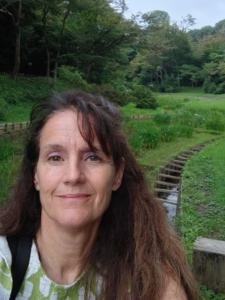 What can a gaijin (foreigner) do, with no language and no knowledge of customs? These were serious challenges on Okinawa, and I can’t imagine what they all are here, but I fell asleep at 9:00 p.m. and I slept until 4:00 a.m. which is when we get up around here and I look out and I see the gardens surrounding our hotel and despite the rising sounds of an incredibly busy City I feel deeply at peace.
Goals for the upcoming days:
- Visit city shops and Shibuya crossing, the busiest intersection in the world.
- Take the subway train to save time.
- Find good restaurants and eat there.
- Meet Tokyoites and have meaningful interactions without speaking Japanese.
- Visit a Japanese bath.
- Climb Mount Fuji.
Japan Trip Series of Blog Posts:
Day 1: Leaving on a Japan Trip
Day 2: At 32,000 Feet, Flying to Japan
Day 3: A Perfect Day in Naha, Okinawa
Day 4: Walking Around Okinawa
Day 5: Visiting Yomitan Pottery Village
Day 6: Tokyo is Fabulous
Day 7: Shopping Day in Tokyo
Day 8: We Climbed Mount Fuji
Day 9: Last Day in Japan


