

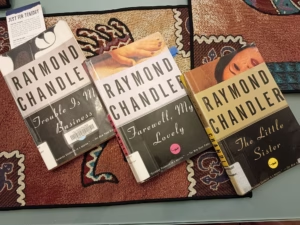
 I met Phillip Marlowe, private eye, some weeks ago when I went to the library and determined that I was going to find a book to read that was perhaps a guilty pleasure, that I would see sitting on the shelf and would pick it up and, clutching it close, sigh and plan my escape. And I did.
“Far too many people get killed in these stories and their passing (is) celebrated with a rather too loving attention to detail… “ Raymond Chandler (the author).
I found, on the mystery shelf, hardboiled crime thrillers by Raymond Chandler. The Little Sister, Trouble is my Business and Goodbye my Lovely have transported me across distance and time into a world of 1930’s Los Angeles, a world I would not want to inhabit … except as a spectator.
Phillip Marlowe, Private Eye
He works for $25 a day and expenses, although sometimes as in The Little Sister he works for less and occasionally he seems to be working for free.
Phillip Marlowe is the quintessence of the hard-boiled detective hero. Marlowe was once a policeman, unjustly thrown off the force, and now his office is in some building in LA’s downtown, some dusty, forgotten corner of the city where you might think nothing important ever happens.
There is a front room in his office for a secretary, but Philip Marlowe has no secretary. He’s too poor. He sits in the back office behind a frosted glass window and waits for business. Glamorous and mysterious women come through the door and begin to tell him stories which he knows are not true.
These women and the thugs they hang around are not everyday people and for the most part their crimes are too small or too secret to read about in the papers. But for them it’s serious, as serious as Big Money is to little people, so serious as to risk death.
Philip Marlow is too poor to get married, he tells one of these “lovelies,” and anyway, the type of woman that would marry him, he wouldn’t be interested in. He is the perpetual loner but this frees him to work righting wrongs in the underbelly of society.
The reader soon figures out that in Chandler’s books, one murder leads to another. And another.
The characters who are murdered are the same as the characters from Damon Runyon’s Guys and Dolls and not dissimilar from Fitzgerald’s gangsters in The Great Gatsby. Inhabiting the seamy side of Los Angeles, they are a regular pack of sharks trying to feed on the weaker fish of society. By the end of the book there has been an operatic progression of violence which leaves most of the characters deceased.
For me there’s a great mysterious catharsis in all this.
The Streets of Los Angeles
Marlowe is on the way to a restaurant when a friend tells him:
“I used to like this town … a long time ago. There were trees along Wilshire Boulevard, Beverly hills was a country town, Westwood was bare hills and lots offering at $1100 and no takers.
“Hollywood was a bunch of frame houses on the interurban line. Los Angeles was just a big dry sunny place with ugly homes and no style but good-hearted and peaceful …
“Now we got the big money, the sharpshooters, the percentage workers, the fast dollar boys, the hoodlums out of New York and Chicago and Detroit–and Cleveland. We’ve got the flash restaurants and nightclubs they run, and the hotels and apartment houses they own, and the grifters and con men and female bandits that live in them, the luxury traders … the riffraff of a big hard boiled City with no more personality than a paper cup …”
They pave paradise, and put up a parking lot.
I lived there in the 1990s, 50 years after this book was written, but I can recognize the streets of Los Angeles. The weather is Los Angeles, the indolent insects flying through the office are Los Angeles, the big cars which go around and around and around roads, which no one knows where they end, is Los Angeles, and so is the drinking and the smoking. And the hills.
Phillip Marlowe lives downtown on the 4th floor of an apartment building of a type they no longer build. Its a tiny apartment made up of a living room, a kitchenette and a dressing room behind the Murphy bed. He goes there for drinking, smoking, sleeping and frying things. Disturbingly often the bad guys get in his apartment. Sometimes he gets beaten up there. Sometimes someone else gets beaten.
Philip Marlowe walks through the streets of Los Angeles night and day looking for clues to help people in trouble. Marlowe will find out what’s actually going on, after getting beat up once or twice.
These are the gigs practiced by these thugs in Los Angeles: gambling, blackmail, stealing, sale or laundering the sale of stolen property, fixing elections and selling drugs.
Vacant lots are everywhere and you better stay out of them or you will be one of the murder victims in these stories. Marlowe’s escape from murder perhaps lies in his unassuming personality, his non-combative way of speaking and his strange way of being part of the fabric of the town itself.
Again and again Marlowe follows his instincts and tracks down the bad guys and even though he gets drugged and sapped (knocked out using a blackjack) plenty of times he slips through their criminal fingers and prevails, if only by surviving.
Bars and restaurants of every description populate the novels. Booths, bar stools, shot glasses, pay phones, a dock where questionable merchandise goes on and off boats. Homes of society people with huge draped Hollywood-styled rooms where unsuspecting detectives can be bushwacked. Dive bars where unsuspecting detectives can be bushwhacked. Society restaurants and so so many women wearing hats.
It’s a world of wonder and yet so familiar.
The Women of the Hardboiled Crime Novel
These are glamorous women with lavender eyes and hourglass figures who are never, it would seem, are who they originally claim they are, and who are never, it would seem, the good women that one must assume live somewhere in this old Los Angeles. Those do not live in Phillip Marlowe’s neighborhood.
These women saunter in and play on Marlowe’s natural desire to help and protect helpless women, but they always turn out to be not completely helpless, and they always turn out to be the source of their own crisis. These days, we might say Marlowe has a codependent relationship with a certain type of woman criminal, but it’s not truly dysfunctional here, this is his life, these are his women, and this is the genre. The women tend to carry an ivory handled pistol in their purse, and most of them can shoot. Their chief weapon, however, is beauty, combined with surprise.
The rich women here are the married women, for the most part. They own expensive jewelry which is stolen, have inappropriate relationships which might be exposed, wear incredible outfits painstakingly described – and none of them has plain brown hair.
Why Read the Hardboiled Genre?
All this is a pretty comprehensive description of books which were written between the twenties and the fifties and were titled the hard boiled murder mystery genre. What does it mean, hard boiled you ask?
In a regular murder mystery someone gets murdered. In a hard-boiled mystery there’s a lot of people getting roughed up or murdered and worse. Some of the crime descriptions are hard to shrug off.
Guns are everywhere. Every man seems to wear a fedora, a suit, and a shoulder holster under his jacket. The police detectives and the cops in general are indistinguishable from lawless thugs except for their general mission: to catch criminals instead of to be them. Everyone shoots.
The ultimate game of cops and robbers is played out every day in the pages of these books.
The police department is rendered as vacant rooms with chairs and tables and not much else and detectives drinking black coffee go through the procedures to solve crimes with no technology whatsoever … unless you count a telephone … word of mouth, people questioning, intuition, who you know.
Chandler came to LA in the 20’s and worked his way from picking fruit up to an oil company vice president in Los Angeles, and had also served in the trenches in World War I. Using the famous pulp fiction magazine the Black Mask as a model, Chandler taught himself to write hard-boiled fiction and published his first novel at age 42.
He later wrote about the genre:
“As to the emotional basis of the hard-boiled story obviously it does not believe that murder will out Injustice will be done – unless some very determined individual makes it his business to see that Justice is done … (doing that was) hard dangerous work: It was work they always could get, there was plenty of it lying around. There still is.”
Philip Marlowe has been called the quintessential American hero and the hard-boiled genre gave Hollywood plenty of vehicles for the likes of Humphrey Bogart including The Big Sleep and The Maltese Falcon.
But for me these Hollywood representations do not completely encompass the reason why we read hard-boiled fiction.
It is ultimately a strangely hopeful genre as the hapless every man private investigator, so unknown and yet the best man in the story, through luck and perseverance and hard work and fortitude works his way through problems of dangerous people that seem insurmountable.
All fiction is, I believe, an attempt to recreate our emotional reality in a different milieu. The hardboiled hero, then, represents us as we go through our difficult and yes, somehow scary lives.
Thus Phillip Marlowe is a beacon of hope, a strange one I admit but nevertheless I would argue that the hard boiled genre is ultimately a hopeful genre. Marlowe unmasks the liars, unravels the mystery, and stands by while lesser men weave their own destruction, then walks away unscathed. We read hardboiled nonfiction not just for the excitement, not just for the seediness of the underbelly of Los Angeles or other cities, but for the strange hope it provides.
If Phillip Marlowe prevails, if Marlowe escapes, perhaps we will too.
Background:


