

The movie is great if you liked Interstellar, and Inception. But for me, this big pic (IMAX sized) visual spectacle lost the heart of both its main character and the culture from which the story flowed from the very first scenes.
Director and media darling Christopher Nolan can do no real wrong at this point, and his self-written adaptation of the Odyssey has, as far as I can tell, encountered no significant critique from Big Media. He can have some here, from the smallest of the small bloggers. His decision to use the biggest media possible (70 mm film) when adapting a poem that was originally transmitted orally is a big shift in media. It turns into a big shift in values and value, as well, we will see.
Before it was a Movie, the Odyssey was an Epic Poem …
Recited, and then it became a book. Two thousand years later, it became a movie. Some artistic values have been gained, and others lost, as the story was told and retold.
This review isn’t for you sword and sorcery types, so an apology could be in order, along with the one for overintellectualization, like in the Last Love Song review of last week.
I Came to Homer in Book Form First
My first encounter with the story of the Odyssey was with a buckram covered book that I got from a book-of-the-month-club-knock-off called “The Classics Club.” This distant relative of the Book of the Month Club, which I also belonged to at one time, specialized in sending you “the greatest books ever written” in cheap reprint form. As I remember, as I experienced it, the book was an ancient translation, perhaps as old as Chapman’s, (referenced in John Keats’ sonnet On First Looking Into Chapman’s Homer (1816)) and impenetrable, as was the Classic Club’s Iliad.
It wasn’t until later, when I was a student in Ancient Greek, that I received a more modern translation, by Richmond Latiimore, (called “the gold standard for generations” by University of Chicago Press) and finished the book. At the same time, we read the first 10 lines of the poem in Greek, the “proem,” and the chapter covering Polyphemus, the Cyclops.
So the Odyssey is a difficult text. Think of the expression, “it’s all Greek to me.” Often taught to teenagers, but rarely understood the first time around. Still, I’m no teenager, and as an amateur student of the classical world, including ancient Rome and ancient Christianity, after watching Odyssey 2026, preparing to write this review, and reading the reviews of the 2026,I knew that I was on the wrong side of history again.
Departing From Homer
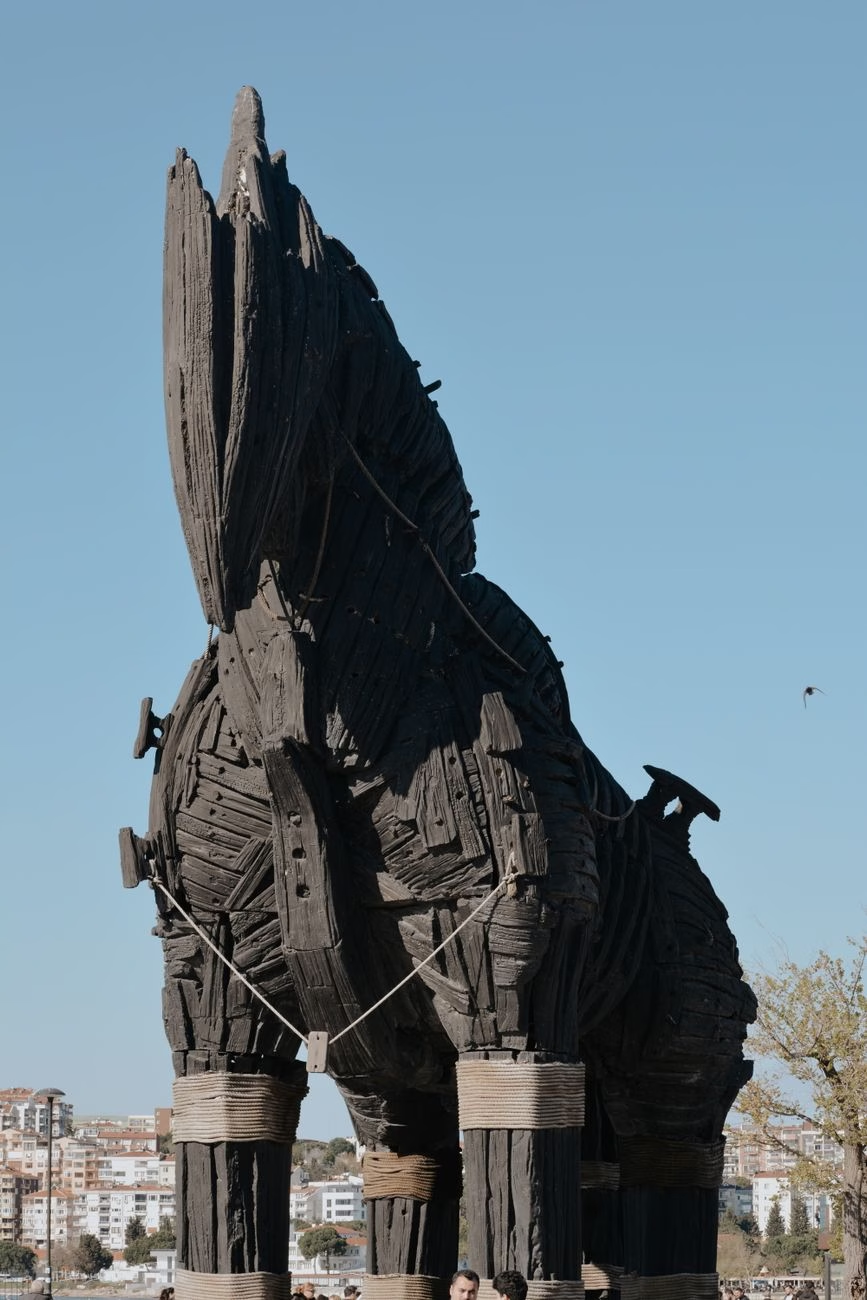
Let me start with this: the Trojan horse pictured in the trailer, is a trope itself, meaning “something you use to get into a locked cadre of some sort) but the Trojan Horse in the movie is not something that could have been produced in wood in the ancient world. The scene in which the Trojans stab a man through the horse’s slats is ridiculous; if they thought anyone was in there, they would have actually investigated …
But an audience will be entranced by the visual spectacle, and will not ask such questions. Perhaps I was handicapped in enjoying this spectacle because I actually had vertigo, since we sat very close to the screen. I closed my eyes during certain parts of the movie, including part of the sack of Troy.
Early in the film, I said to my friend who was watching with me, “This is departing from Homer.”
“He’s following the Aeneid,” was the reply. Referencing the great Roman epic, which details how the surviving Trojans left Troy to found Rome, and, unlike Homer, is generally assumed to be largely fictitious and not based on actual events.
This is a good description of the 2026 Odyssey, actually. Not trying to base a movie on actual historical reported events. We’re going for effect. And the effects are soaring and magnificent.
The problem is, effects don’t always work for me. I’m a literature person. What I love about the ancient epic, the understanding of the human condition, the depiction of a man triumphing over hostile fate through ingenuity and through faith, is somewhat lost in the sounds of the banging swords here.
I love the Odyssey with a passion that is almost religious and I can’t stand by and see the movie granted undivided adulation without saying hey, so, yeah, it’s cool, but you are all missing the point.
What point?
Let me see how much of the proem, the beginning of the poem, that Homer set aside as a summary. I think I can still remember the verses, 35 years after I was told to memorize it.
Sing, muse of a man of many wiles,
Odysseus, sacker of cities,
Many were the men whose minds he knew
Many were the sufferings he endured, many were the cities he saw, struggling to obtain the Nostoi, the return home
For himself and his companions,
Even so, he could not obtain the return for his companions,
Fools, who ate the oxen of the Sun God, Hyperion
And thus they were destroyed
Of all these things, Goddess, daughter of Zeus,
Tell even us.
This is my memory. There are several clauses missing; however, most of it is there.
I find this problem with Odysseus the Movie. Nolan has skipped the central theme of the original story, that is, the Many Wiles of Odysseus. Matt Damon was well cast in Oppenheimer, as a general trying to follow the rules while allowing physicists the freedoms they needed to be productive. He was, I say, miscast as Odysseus, he just doesn’t seem wily enough.
Of course, he does get a characteristic to define him: moodiness. Thinking, sitting in the ship staring out to sea, making decisions that seem to fail as often as they succeed (like the one to sail across the Mediterranean and raid for food, which didn’t go well and isn’t in the original poem) and apologizing to the dead Sinon.
I think to myself, “where in this movie did Odysseus show his wiles?” Not in the Trojan Horse episode, which barely mentioned Odysseus’ creation of the stratagem. Not in the Cyclops episode, which in the poem is a masterpiece of spoken dialogue in which Odysseus addresses the Cyclops and negotiates with the creature, winning the concession from him: “Noman (which Odysseus says is his name) I will eat you last.”
Then after the escape, which was drastically simplified in the movie, when the Cyclops tells the other Cyclops that “Noman was killing me with treachery” the other Cyclopes misunderstand and won’t help Polyphemus pursue the Greeks.
And Odysseus’ wiles are not shown in the ending, more of that, anon.
The Women of the Odyssey
The script, then, as I would claim, misses some opportunities. Odyssey translator and Homeric scholar Emily Wilson of the University of Pennsylvania says that Nolan shouldn’t have written the movie himself, and should have hired a writer. What concerns me in addition is the timeline that was given to the writing of the movie; apparently, according to Wikipedia, Nolan started his work on this in March 2024 … I’m gonna say that that’s not long enough for a project of this magnitude.
I am with Wilson 100 percent when she says that feminist critics see misogyny under every rock. Nolan’s women are not particularly sympathetic, even Penelope, who among the ancients had the type of idealized wife. In general, the women of Homer’s poem are far more nuanced, intelligent, beautiful and powerful than Nolan’s.
Elon Musk apparently complained that this movie has a diverse cast. Actually, I thought the diverse cast was good. Lupita Nyong’o, our Black Helen of Troy made the most of what the script gave her. And the enigma of her scarred face well-represented the irony offered by Helen: the beauty that launched a thousand ships … and killed many thousand people.
Helen does, however, offer one of the anachronistic incursions of the film: saying that the Greeks wanted to start a war with Troy for economic reasons. This is not something an ancient person would have come up with.
And then there’s Circe, the enchantress with whom, in the poem, Odysseus and his men spend a happy year after he forms an assignation with her … my friend the classicist was rather horrified by this mischaracterization, and as he said “she’s like a horrible woman professor from the English Department” a characterization which I cannot say is unfair.
The New York Times had this to say: “Nolan’s Odyssey ultimately reduce(s the conflict with Circe) to terms the director is most comfortable with: Odysseus is a man burdened by the weight of his brilliance. Circe is an obstacle he must overcome … “ (the review, dated July 27, ‘26, is titled ‘The Odyssey’ Should Have Done Better by this Character” and can be seen only if you have access to NYT.) Well said.
At another part of the movie, when Odysseus’ wife Penelope (Anne Hathaway) says “our civilization is collapsing” and talks of marauding “sea people” she is referencing a concept (civilization and its collapse) that wasn’t really known until the fall of the Roman empire around 400 AD. Perhaps it wasn’t really known until Edward Gibben and his 6-work volume on the Decline and Fall of the Roman Empire. Penelope further muddies anachronistic water when she speaks as if a modern feminist; why can’t she just be queen, doesn’t she know enough to take the throne?
Oh my God.
This is where I feel Nolan’s script is at its most anachronistic. A real historic Penelope would never say this. Not because she’s been taught not to say it by repressive patriarchs, but because the world in which she lived was fraught with war and only a war chief who could inspire men could lead it. The fragility of the survival of such peoples rested on a type of specialization we no longer understand: women took care of the survival of the people in the realms of home, childbirth, care, sustenance, clothing, management of the resources. Men took care of the work of war and farming and hunting. This wasn’t about fair, this was about survival.
Then we have Kalypso, who Homer called “shining among Goddesses,” and played by Charlize Theron who seems (and even looks) somewhat like my friend the psychologist, the beautiful and insightful friend who helps you understand your past and your feelings. In this movie, Kalypso also feeds him lotus leaves to keep him quiet. That’s not who Kalypso is in the actual epic, in which Hermes goes to her and says “hey, you’ve got to let him go back to his family,” and with whom Odysseus has been trapped for 7 years, all the while crying on the beach for his family.
New Wine in Old Wineskins
The film is not looking for understanding of character or understanding of history. Some have said the movie is looking for an Oscar, but we will see. At its strongest points, the movie is about our civilization, which is (in Nolan’s opinion, perhaps) collapsing. The focus on guest-host relations here is clear, and the irony between the way Odyseus treated the Trojans and the way he expects to be treated by towns he raids is clear. But these are modern thoughts, new wine in old wineskins, bound to burst with only a little exposure to time’s ravages.
There’s something otherworldly in the menace of Odysseus’ Mediterranean; the Lastroygonians are bizarre in the armor which is 2000 years too late in style, and which reminds one of 1982’s Excalibur. The Cyclops was created using a huge puppet, and was plenty horrifying. Particularly with his eye going sideways. Scylla and Charybdis were well-manifested, and here Odysseus did show some ingenuity, thwarting the will of the Gods to kill his men in the whirlpool. But overall the monsters of this ancient world seem imported from movies of the last 75 years.
The trip to Hades stayed pretty close to Homer, and Tiresias’ message was basically right out of the poem – however, when the dead started chasing Odysseus and his men back to the ships, it was like a Zombie Apocalypse – new monsters in an old story.
The Good Parts
Yes, of course there are good parts. One of the best is Antinous, the chief of the suitors. Robert Pattinson gets it just right, and so does the script: this man, a dishonest opportunist, is not only the most vile of the suitors, he provides a thumbnail sketch for what the suitors are all about, so those who don’t know the story too well won’t feel bad if they are killed.
The blind shepherd, Eumaois, is true to type, played by John Leguizamo longsuffering, loyal, and forbearing.
As I said, the diverse cast, interestingly, were generally excellent pics for the parts – standout of these was Himish Patel as second in command Eurylocus, arguing with Odysseus and representing, like Antinous of the suitors, the general character of Odysseus’ men, their rebellion, downfall, and their unsavability.
The ship is beautiful and seems historically accurate, sailing on Homer’s wine-dark sea … and the fact that the movie was shot on location is no small thing. Everyone who’s seen this movie has seen a good a quick view of sites in ancient Greece. White cliffs of the Aegean …
Themes that arise in this Odyssey Which are Missing in Homer:
The entire matter of blood guilt for war, as I have said. But also this idea that Odysseus must pay back Odysseus crewman Sinon, who stayed with the Trojan Horse and was killed when the horse was found, is missing in Homer and numerous other sources, in which Sinon survived.
An example of how this effects the conversion is found in The Conversation, which actually dares to claim Odysseus is some kind of violent housebreaker … if you had read Homer, you would realize that Odysseus actually just stole a little cheese and wine, and offered to pay for it, but the Cyclops responds by eating two men. This is the kind of interpretive problem you can wind up with when you depart from the text. You see, with the reinterpretation it doesn’t tell us who the people of the past were … it tells us who we are. And we, quite possibly, already know enough about that.
The Problem with Making Ancient Characters Modern
This is the problem: if we change the characteristics of the ancients, if we downplay Odysseus’s cleverness in favor of a brooding guilt that’s all too 2000’s, we lose the opportunity to triangulate on the commonalities between our time and his that make us so deeply human. For example, the love of home, the love of dogs, of all things – Odysseus’ dog Argus is one of the details that Odyssey 2026 got right – and the commitment in a good marriage. These things transcend the years, therefore they must be distinctly human.
The Ending
The ending of the Odyssey is a difficult one by any reading. Though staying close to the original poem, Nolan’s script shows Odysseus having more trouble dispatching the suitors than in the epic. In fact, to me it appeared that after killing a couple of dozen, the rest of the suitors surrender. This too is not according to Homer, who has Odysseus killing all the suitors, with the help of three loyal servants, and also the 12 serving maids who were in cahoots with the suitors.
This departure doesn’t make sense to me, unless Nolan himself was affected by the same guilt that seems to plague Odysseus throughout the movie, a kind of ancient PTSD in which the visions of the vanquished Troy and its dead torture him.
There is no record of this guilt in the Odyssey epic poem. In fact, some commentators have noted his lack of remorse, and explained that such remorse would be simply inimical to a survival subsistence culture like ancient Greece.
Nolan gives us an ending with Odysseus sailing off into the sunset, and Penelope intoning the words of H.G. Wells: “Civilization will rise again and the stage will not be forgotten.” This is not about the Odyssey. This is about Nolan’s interpretation of the Odyssey. Perhaps his kleos is the real goal here. But I’m not going to explain kleos. If you want to you can look it up.
Younger People who have Read the Odyssey Poem Speak
I gave a short summary of my response to the Odyssey 2026 to my daughter, who’s at home after the birth of a sixth child. She is not too concerned with such things as literary or movie interpretations. She’s more concerned with sleep. But she summed up all this review in just one sentence, with the efficiency of mothers everywhere:
“Well, the movie is never as good as the book,” she replied.
A younger person (high school senior who’s read the Odyssey in translation) said “there are some virtues that Odysseus had, that aren’t in the movie. But it was good!”
I thought about this, as I walked past the piano, and saw the Odyssey of Mary Pope Osborne, who has written a children’s adaptation.
The movie is never as good as the book.
Unless, of course, you didn’t “get” or read the book in the first place. Then it can pass.
A List of Digital Texts for Understanding Homer and His Interpreters:
Michael Wood, in Search of the Trojan War Episode 1
Odyssey Greek Poem Composed by Homer – Wikipedia background
Director and writer Christopher Nolan – Wikipedia
The Odyssey 2026 film – Wikipedia
Aeneid, 19 BC – Wikipedia
Odyssey Translation by A.S. Kline,, Available online in its Entirety

