

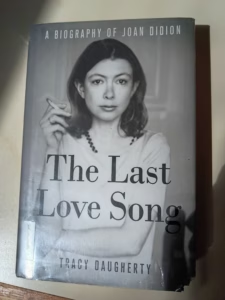
 Book Review The Last Love Song by Tracy Daugherty
Book Review: We Tell Ourselves Stories in Order to Live by Joan Didion
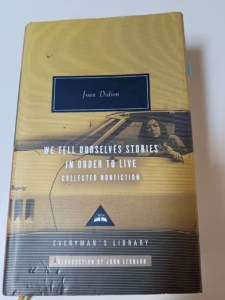 This is a book review for the intellectuals who read this blog, such as Sue, my travelling partner on the Japan Trip. My description of this pair of books will be somewhat more discursive than previous reviews such as The Man Who Knew Too Much. Furthermore, although it started as just a review of Last Love Song, by Tracy Daugherty, the review needs to be combined with notes from another book, We Tell Ourselves Stories in Order to Live by Joan Didion. If you have read anything by Didion, including her masterwork, The Year of Magical Thinking, that will give you enough background. If you even know who she is, in fact, you might be okay. But I refuse to keep this simple. It’s just not possible.
For some time, all last spring and into this summer, I have been engaging in a Joan Didion study. This has involved reading several books, including a compendium of her nonfiction, called We Tell Ourselves Stories in Order to Live, which I actually had to buy because it is over 1100 pages and I couldn’t get through it in time before the library wanted their copy back. You see, Didion is an important author in this way: people really read her work. Even now, after she’s gone. her work sustains her name without an “influencer” to keep pumping air into it. People put holds on her anthologies. That alone is a huge validation of her work.
I know, I know, my thoroughgoing study of a single writer comprising 1000’s of pages seems over-the-top. But Didion somehow beckoned me into her world, with that quote that has been borrowed since then by writers everywhere: ” We tell ourselves stories in order to live.” This quote actually showed up in my life originally in a book called West of Jesus, a surf memoir recommended by an old friend. I was intrigued. West of Jesus was a study in ontology, existence, reality, and belief, and it was solid. This was a good recommendation for Didion. I had already been impressed — and yet troubled — by the Year of Magical Thinking. That was when I ordered this Didion nonfiction collection from the library. And once I started reading, I was hooked.
Honestly my Didion obsession didn’t seem reasonable to others. “Why are you reading all her work?” more than one friend asked, suspiciously, when I told them. (not actually all of it, just what’s generally regarded the important parts, the non-fiction. And I skimmed Miami and Salvador). “What do you hope to gain?”
“Because, I feel she has answers to a couple of important questions. One, what does it mean to be a Californian. And two, how to be a nonfiction writer.“
The problem with my questions is that Didion’s truths are somewhat elusive. It came to me right away, back when I was reading Magical Thinking … that her stories were not completely reliable. To the writer’s natural toolkit, which is to edit and to illuminate, to push details forward and to pull others back, Didion seemed to be particularly adept, and then there was the matter of skipping huge blocks of her life in her memoir writing. She claimed to come from a poor family, when the opposite appears to be true. She claimed to love New York, when to her mother she wrote the opposite. She said she was a conservative, and she wrote for the National Review and attacked the whole feminist idea … yet by the 80’s, she was a liberal’s liberal, working for Hollywood glitterati and travelling to the jungles of El Salvador to try to stop the right wing thugs backed by … it was suspected … the CIA. Or worse.
I needed context and it was context Didion’s work was not going to give me. Enter The Last Love Song, a biography by Tracy Daugherty, essential to my understanding of the Didion corpus. Almost as long as my book of collected nonfiction (lets call that work “We Tell Ourselves Stories” and Daughterty’s work “Last Love Song“), and in its own way, more illuminating.
It was not possible, in the pages of We Tell Ourselves Stories …, to discover what Didion actually had done when she was in New York besides writing for Vogue and National Review. Didion was a master craftsman, who nevertheless embodied, more than anyone else I can think of, the characteristics of the unreliable narrator. Her picture on the cover of her book, a professionally shot image for her smoking a cigarette in the window of her corvette, struck me as staged even for an author portrait. The Corvette, the car of the egoist, like an oversized coat, seemed a strange choice for the most serious of serious writers. And yet not. What was she saying? She declined to state.
One critical story that Daugherty brings up concerns Didion’s close personal friend from her New York days, Noel Parmentel. This was a man who Didion appears to have been deeply attached to, and who she also later wanted to pretend didn’t exist. All women, perhaps even all humans, can remember someone like this. But Parmentel had a pronounced effect on Didion’s career, introducing her to editors at places like National Review and the New York Review of Books in the days when it was assumed by many that women couldn’t really write.
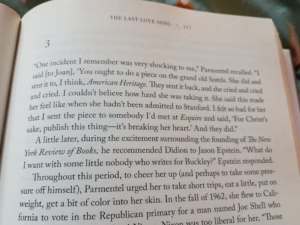
This is not the starlet’s sleeping you way to the top. But it is putting all your eggs in one basket. The writing basket. And Didion did.
And then there was this. Eventually, Didion married John Gregory Dunne, a fellow writer. The marriage was durable, but the lack of romance in Didion’s writing gave me a feeling that happiness in this area was not profound. Daugherty runs this thread down. Early on “Dunne often told friends at parties … that his marriage was a week-to-week affair.” Building on her comment in essay that “we went to Hawaii in lieu of getting a divorce,” a portrait emerges of a difficult (at least initially) marriage. This after reports of the Noel Parmentel situation gives us a picture of a woman who had to rely on herself, yet wanted so much to connect with others. Daugherty deals, briefly but still, the reality that Dunne eventually had to face the fact that his wife’s writing was regarded more highly than his. This is not something you could find in We Tell Ourselves Stories.
Then there is the question of Quintana, her adopted daughter. The reports Didion give in her nonfiction are of Quintana’s ideal life. Quintana is described as “the perfect child” and Didion, like my own mother, puts a great deal of effort into dressing her daughter well. Putting up a good presentation. Maybe a little bit of being better than other people. Initially, Didion seems to see herself as a really good mother, yet there are cracks … What really happened? Why did Quintana die? Her symptoms make no sense. Daugherty researched this background question with interviews and time and place research. A picture emerges. It’s not a proof, it’s not a reason. But the situation is no longer a somewhat bizarre narration that doesn’t fit the facts. What does the phrase “the perfect child” even mean? It is, perhaps a smoke screen. There’s an old saying, “saying it’s so don’t make it so, Joe.” But actually, if you never check the background, it does.
Especially on “the internet.”
After her parents are dead, Didion talks about her California roots in “Where I was from.” Daugherty colors in the edges, checks school records and finds details of Didion’s friendship with the governor’s daughter, of her excellent scholarship, or her neurotic behavior as a child. He doesn’t say “actually this is what happened.” But at some points, that’s rather the effect.
The Last Love Song also tells of how Didion and Dunne became closer over the years, how they learned to write as a team, for the movies, yet it seems to this reader that the writing for Hollywood was somehow a sell-out. Their jet set lifestyle appears in her work without a cost accounting. Daugherty explains. Didion and Dunne made as much as $150,000 a week on script doctoring projects, spring boarding their services by selling themselves at parties given by Dunne’s movie producer brother Dominick, whose promotion of their endeavor certainly lent support to the old claim “it’s who you know.” Daugherty provides background on the Dunne clan, six children, and their difficulties and struggles, and a couple of notable tragedies, which occurred in the midst of some fabulous successes.
Dunne and Didion are no longer walking on water now, thanks to Last Love Song, with me. They are human. And that’s a big improvement, actually.
This is what Daugherty did.
He gives you the background and you make your own conclusions. My questions: why couldn’t Didion have children, why did Quintana die, what really happened in New York, were all answered, and not with a “mike drop” moment, but with details that were gleaned from interviews and from the fiction and even school records which are offered to the reader like the clues in a detective novel. No one tells you what it was. But by the end of Last Love Song, you feel like you know the Didion and Dunne partnership as well as you know your own family. They are no longer like literary movie stars, whose fame depends on something semi-divine, given to some and not others.
And if I started reading these books to learn about being a nonfiction writer, it is as much Daugherty as Didion who gave me my answers. John Dunne, with his quote, “writing is donkey work,” partly explained it. Didion, with her words about a reporter’s job is to go there and get the story, explained it. These were from Last Love Song, not We Tell Ourselves Stories.
Going to work and working hard are not part of the jet set lifestyle. To read We Tell Ourselves Stories, you don’t ever see any work happening! Writers … just produce beautiful things by breathing!
No.
Daugherty sheds some light on the effect that Didion had on young women of her day, but he also sheds light on the fact that Didion had trouble connecting with her adoring fan base. The reader was faced with the possibility that writer and fans loved each other without understanding each other.
Which was a situation echoing Didion’s family life …
Fiction vs. Nonfiction
Another thing I’m grateful for is that Daugherty gleans info from Didion’s fiction. Which I knew I did not want to read. I don’t know how I knew. Perhaps I was sure since I found so much troubling in the non-fiction that I would rebel against her fiction. The fiction is considered her less-important work anyway. Which might be considered too bad, since so many writers want to be novelists.
Although in recent years there have been so few really first-rate novels that I’ve begun to veer into the nonfiction shelves more and more just on principle.
Here today as I’m writing, overhead, the sky goes dark, and thunder booms. It is late afternoon, around four. A couple of large drops fall on the wooden patio outside my bedroom. What have I learned about nonfiction? Is the sky telling me the future for fiction in grim? Or to listen to the master writer?
Didion Knew Nonfiction
I do not know. But Didion knew nonfiction like nobody else. And, unlike many other nonfiction writers, I could parse her techniques enough to conceptualize emulation. This is huge. As I write this, I hear the huge round drops of a summer rainstorm hit the skylight. Ah, rain in the summer. My favorite weather. Writing, my favorite way to spend time.
Didion knows how to hook the reader. “This is a story about love and death in the golden land … “she begins in the murder essay “Some Dreamers of the Golden Dream.” Who could stop reading? (Murder essays, by the way, if you read serious magazines all the way from Texas Monthly to the Atlantic to the New Yorker, are bread and butter stories, but you have to tell the reader why this murder is different.) But Daugherty is the one who tells you that she learned how to do this at Vogue, where she was a staff writer and junior editor.
Didion collects vivid details like no writer ever, the memory of her afternoon in Death Valley putting ice cubes on her back will not fade … But I find myself wondering about her veracity when she reports desert sinkholes with water that grows warmer as you go down … as if there’s a nuclear test site under the aquifer. I go back and read it again. I see that she doesn’t say this happened. She says people are saying it happened … very different. Yet the story itself is similar in impact on my mind.
I see how she did this. She realized that it didn’t matter if it actually happened, as long as the story bloomed in the reader’s mind. What does it matter to the reader if there was or was not a pregnant teenaged bride at the edge of the desert sinkhole looking for the body of her dead husband? What Didion was saying was that this is the kind of idea you come up with when it’s 120 degrees. This is your emotional experience. And on some level, an emotional experience is real even if the facts never happened.
This is what Didion Taught Me About Writing.
That it’s the reader’s emotional experience that matters with writing. And no other writer ever got through to me. Maybe it won’t make a difference. But if it does, I won’t be able to stop thanking her.
As some point in the 80’s, Didion’s writing took off for the political. It seems she got quite involved with editors at various New York publishers, at the New York Review of Books, and the Hollywood People, who’s political action has been documented elsewhere, and these involvements began to shape her political beliefs, until she felt compelled to write two books, Salvador and Miami, which seemed less well received. The funny thing is that with Salvador, she was treading the same trail as my mother, who went with California senate political friends to Guatemala in the 80’s in order to see what was going on … thinking they would understand and help make some changes …
My mom and Didion were moving in parallel worlds. This intrigued me. It would seem that people were moving in the same directions, rhetorically, at the same time, basing these actions on political ideas that seemed to come from the success of the ending of the Vietnam war. The success of that movement was not to be repeated in their lifetime, however.
My mother came back from Guatemala and said there was no way that outsiders, like herself, would be able to change things there. I could say more, but Daugherty, in a quote I forgot to mark, explains why I don’t when he told another key writing insight gleaned from a Didion friend:
I’ll paraphrase.
Writers deal with things they know and can say, things they don’t know, and things they know but can’t say. From this matrix they must come up with a worth-reading story. This is huge. The very fact that we are sponging around saying things that we know, that maybe everyone knows, that are impossible to say because … slander? libel? Offended family members, I don’t know … but it’s so true. You know things, and you can’t say them. I do believe that in Claire Harmon’s Charlotte Bronte she identified the need to say things under a disguise, things that can’t be said baldly, was the reason for the rise of fiction.
By Chapter Thirty-Four of Last Love Song, Daugherty notes that in 2001, Didion’s book Political Fictions came out, and claimed that American had a “vassal relationship to the government under which they lived … ” (dictionary definition of vassal: “a person in medieval Europe who was granted the use of land (a fief) by a lord or monarch in exchange for loyalty, military service, and protection … ” ) suggesting, but letting the reader determine, that Didion’s ability for political hyperbole was reaching the top of the pitcher, so to speak, about to spill over into making a mess, particularly since the book came out on September 11th itself.
Political Fictions was less well received that much of her previous writing. I would venture my conclusion that her keen mind and writer’s instinct had been blunted by many, many years of parties in Hollywood, and lunches with magazine people in New York, and echoed a phenomenon I’ve seen in my own family, and which we see to this day, where the left has come to believe there are no other possible conclusions about current events than their own, even when their own conclusion move into conspiracy theories and hyperbole.
The left ignored the potential for alternative conclusions, both about what was happening and what was important, to their peril and now … you see what has happened by 2026. But I digress.
And California Dreaming
Didion’s nonfiction book Where I was From came out in 2003 and discusses what California is, using such sources as the writing of Jack London. Deeply invested in her portrait of herself as morally worthy because of her pioneer ancestors, Didion also felt that California had somehow needed the Federal government but hadn’t admitted that it needed them. She spends a lot of time on the question of What the Railroad Meant to California, without considering that the railroad meant a similar thing for a lot of different states in the West. Her discussion of the water management infrastructure in California seems to suggest that it is somehow human thought, and not geography, that allowed the irrigation of the desert, when in fact it was both. She repeats that idea that California is the stopping place, that the frontier can recede no more, because of the Pacific.
What I Believe About California
I read all these pages with great care, and felt a massive generational gap. Didion is my mother’s age. Her beliefs were perhaps my mother’s beliefs? But no. My mother agreed about the problems in Central America. But she wouldn’t have signed off on all this. Perhaps the Didion family, her parents and her, didn’t quite understand the state they lived in and acted like they owned.
What I believe about California — that it is a land of unusual natural richness, unusual wealth in terms of higher education and agriculture, more National Parks than any other state, and, along with that, a lot of good people, and bad people, drug addicts, street people, criminals, the Hollywood People, the Silicon Valley People, Google, which took over San Francisco — California, predictably liberal up to the point when largesse to everyone who lived there seemed on the brink of bringing the whole project down, but somehow, because of the excessive wealth of the place, didn’t actually fall apart; California, which to the irritation of the rest of the country, particularly red states types, who feel it would be wonderful when California finally experienced one final earthquake and slid into the sea, managed to prosper long after its demise was predicted over and over and over, and which, like New York, seems to have a leg up on everyone even when they do stuff that they themselves must know is stupid; California has always been the Golden State, it plays true to type, now for 175 years, and, apocalyptic projections notwithstanding, the likelihood is for it to continue doing that. The past, as I have long said, is the best predictor of the future.
We Tell Ourselves Stories in Order to Live
I don’t know if Daugherty pointed this out, and his book is almost as long as We Tell Ourselves Stories in Order to Live, so it’s hard to go back through and find things, but there’s a philosophical problem with the saying “we tell ourselves stories in order to live.” A movie I loved, Arabian Nights (2000) used a different phrase with similar words: “Stories tell us how to live, and why.” The two phrases are very different because the speaker in the phrase is different. In we tell ourselves stories, we are participating in a closed circuit between me and myself … we make things up to justify and explain! We are like the ancients making up stories for why the celestial bodies move about the heavens, without science. This suggests a view in which our stories are self justifying. We did what we did, now we need a reason.
The other phrase, “Stories tell us how to live, and why” is a wisdom-tradition type of admonition. It gives us an older view of story telling, in which wise people, old people, or leaders of any type tell us stories to help us live well. This phrase is 180 degrees different on the purpose of storytelling. This is an explication of what we call the Wisdom Tradition. G.K. Chesterton, in his Everlasting Man, says that the useful wisdom traditions (the Bible, etc.) give us both story and wisdom. This aligns with what Aristotle says, that stories should delight and instruct.
But Didion, even as a young woman, does not seem to have believed in wisdom traditions. I found a quote in her very early essay “On Morality,” from the book Slouching Toward Bethlehem, in which she writes: “You see I want to be quite obstinate about insisting that we have no way of knowing–beyond that fundamental loyalty to the social code–what is “right” and what is “wrong,” what is “good,” and what is “evil.” This essay is from 1965, when she was 31 years old.
Garrison Keillor, whose work I don’t have to go to the shelf and get to quote, had very different words about this same question: “You know the difference between right and wrong. But knowing is not the problem.”
Didion Does Not Believe we Know
Didion had staked out her ground. In the ensuing years until her death, I do not believe she changed this position. Morality is an abstraction. Therefore, we tell ourselves stories.
But I do
I cannot agree, but I’m sure she would say, that is not the point. Remember, you don’t have to have facts, you just have to create a trial of meaning worth following. And she did that.
Daugherty, in Last Love Song, covers the question of her mentality about what writing is. Writing is an argument, she says, an argument with the reader. You try to force them to adopt your beliefs. I found this fascinating when I read it, fascinating because part of why I read this was so I could learn to be like her as a writer. Arguing! I did that more when I was young. Perhaps the idea can be repurposed somehow, to be more useful. I will consider.
We have a saying around here: Nothing succeeds like success. And to know what success is, you can refer to the Chinese Proverb: Health, Wealth, Long Life, Staying in One Piece. Didion had those gifts. And yet …
I probably don’t have to explain at this point that in the end, I concluded that whatever graces and beauties were in the works of Didion, and no matter how much her work was an exemplar of writing, she was probably not someone I would look to on the question of how to live.
To decide how to live, I think we should probably refer to other stories. Stories that teach you how to live … that could be a blog post. I should probably work on that next, now that the massive Didion project is pretty much over. That said, this has been a watermark book study, into the words of Didion and into Tracy Daugherty’s contribution to understanding her, and, as we do to all great writers, I owe them both a debt. This has been a massive epistemological study, as well as a study of writing, and in the end, like so much of the reading we do, it was a good use of my time.


