

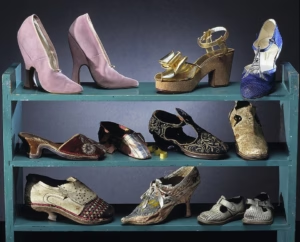
 I love shoes. Long ago I made some Shoe Rules which I do not follow. The most central is that I don’t own, at any time, more than 16 pairs of shoes.
Even though I give shoes to the Goodwill every year, more keep coming in. The t-strap jujitsu flats I bought in Tokyo as the perfect shoes to wear with a dress in my elementary school classroom were the latest “have to have.”
The desire for a shoe is a desire for a perfect moment, a certain opportunity.
I know I’m not alone.
But why do we love shoes?
A perusal of the internet suggests we love shoes because they make us feel tall, smart, beautiful, all those things. And that’s true.
Although it’s not just having shoes, it’s having the RIGHT shoes. You love shoes that somehow simultaneously blend in and stand out.
The quixotic perfect shoe.
But why?
Even if love of shoes is not the goal of life, I think this is one of those things where our memories, and the memories of our mothers and grandmothers, are tied together.
A Personal Shoe Chronology
Perhaps somewhere in the back of my mind, I know: Time was, women (and men) didn’t have shoes. And then, for millennia: not more than one pair.
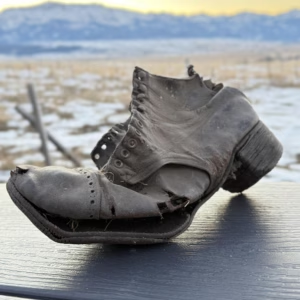 I am fond of remembering the pioneer history of my family, living out on the Minnesota prairie in a dugout house like Laura Ingalls Wilder. The pioneer woman had, I must assume, one pair of boots or brogans. She certainly had no need, and no access, to high-heeled shoes.
When I was a child, I had one pair of shoes, tennis shoes, and maybe a pair of sandals. My parents said there was no point in buying more than one pair of shoes for a kid, you’d just grow out of them.
I can remember my mother’s closet with the shoe holders, at least a dozen pairs of multicolored leather pumps that matched her suits. Womanpower was in that closet. And to my teenaged brain, womenpower came from red and green and blue shoes.
In my late teens, I began to collect. I bought shoes from Marshall’s, from Ross, TJMaxx, from Macy’s, The Broadway. Famous Footwear and DSW and Nordstrom.
In Ontario, Canada, when I lived there as a young woman, we all had to wear snow boots on the street. So many people took public transit, and it could be wet and muddy. Just having a decent pair of snow boots, finding and paying for them, was a struggle. But when you went to your friend’s house, you would bring slippers. Then when you took off your clunky snow boots, you put on your slippers. Properly dressed again. Prosperity. Wellbeing.
By then I was a housewife and I didn’t have a ton of money or a ton of shoes. I had one pair of dress shoes, as I remember: a pair of black pumps to wear to church. Black went with everything. I had moccasin loafers. Maybe I had old tennis shoes.
When my kids began to become more independent, my shoe lust got worse. Shoes of unusual colors drew me. An orange pair of shoes is still irresistible. Green shoes, saddle-colored shoes. Boots that were black, tall and shiny with wedgie heels.
Shoes, even one pair, are a sign of wealth. Twenty pairs are a sign of prosperity. Even if your car is on its last wheels, your carpet is threadbare. You’ve got 20 pairs of shoes, you’re somebody.
There’s an old joke about “why did the woman cross the road?”
The punchline is “I don’t know but how did she get out of the kitchen and where did she get the shoes?” This goes back to the old saw about women being “barefoot, pregnant, and in the kitchen.” Few would even utter this joke today, but I can remember when it was an illustration of “the old way” of thinking about women.
I don’t actually believe that men denied shoes expressly to women to keep them at home. At least not the men in our family. And I liked being at home. But nevertheless, the truth is in the joke: a woman with shoes is a powerful creature.
The Shoe as a Social and Cultural Artifact of Humanity – and Womanity
Shoes and sandals have been developing for around 10,000 years, and during that time, they have often been used to signify social status. The prostitute, the slave, the soldier, the queen, the emperor of the ancient world, all wore specific shoes. These shoes, along with other details, told others who they were.
Poor or no shoes signified low status. Shoes that were truly impractical meant you didn’t have to work.
A Brief History of American Women’s Shoes
This modern shoe overpopulation crisis has its roots in the 1950s, and the industrial prosperity that our country and much of the world has enjoyed since then. But long before that, women were desirous of fancy shoes. These were the main phases of female luxury shoe buying in America:
Colonial Period: 1600s and 1700s – only wealthy women wore dress-up shoes, largely imported from Europe, and made of fabric such as silk and satin.
Neoclassical Flat Period: 1800-1830 – upscale women wore flat slippers, based on the democratic ideals of the American and French revolutions.
Victorian Era – 1850-1890 – sewing machines were invented and high-heels made a comeback. Middle-class women could afford high heeled pumps with sequins and buckles.
Roaring 20s – Hemlines rose, and footwear became more visible, thus more important. Modern women’s dress shoe styles arrived.
1950s – Shoes became more varied and inexpensive, with the invention of the stiletto heel using manufacturing techniques from World War II. Postwar prosperity resulted in a production and sales bloom.
1960s – With so many women working outside the home, more and more pumps and loafers were necessary everyday gear.
1970s – Nike and Adidas made athletic shoes a major fashion focal point. You put those on; you were no longer just a woman on the street. You were an athlete. Fashion shoes showed where you would go, but athletic shoes showed what you could do.
Shoes Denote Status
Shoes denote status. Shoes denote roles. Shoes denote abilities. Why so many shoes? Perhaps it’s my long-standing FOMO, Fear of Missing Out, a desire for opportunities. Riding boots for horseback riding. Dancing shoes for dancing. Hiking boots for hiking. Sandals for relaxing in the sun. Clogs for working in the garden. And a good half dozen pairs for dressing as a professional lady at work.
I could have more shoes. But it bothers me to try to organize them all. So I set the 16-pair limit. But it bothers me to try to limit myself to 16 pairs. So I keep breaking the limit.
The Collector of Shoes
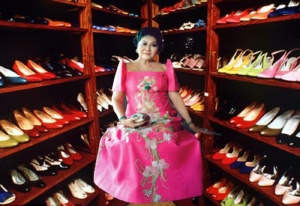 At some point the shoe population becomes so large that we are no longer being excessively prepared, we’re collecting. It’s said that when they discovered King Tut’s tomb, he had 80 pairs with him. And who can forget Imelda Marcos’s shoes? Personally, when I heard the story that she had 3,000 pairs, I was simultaneously horrified and silently thrilled. I imagined the closet, the boxes and the colors. I do not excuse Imelda for her excesses; I only say that I could see where she started from. As the President’s wife she probably could reasonably have more than 16 pairs of shoes. But 3,000 was too many.
So, what is a normal number for those of us who love shoes? After adding the Jujitsu t-straps from Tokyo, I currently own 21 pairs. But I’m going to the Goodwill soon. Promise.
I don’t know how many pairs of shoes other women have. I must ask you, Reader of this blog, do you have more shoes than me or less? Please consider placing your answer in the comments.
I can’t wait to find out if I’m normal for shoe ownership …or not. Either way, I love shoes.
Shoe Notes:
YouTube Videos:
Gospel Singers and the Spiritual I Got Shoes
What Did People Wear on their Feet Before Real Shoes? from Weirdward Bound
Text Info:
A history of women’s shoes from Shoezone
The Shoe Entry on Wikipedia – significant historical notes.


