

Adjective: Picaresque: 1. relating to an episodic style of fiction dealing with the adventures of a rough and dishonest but appealing hero. Noun: Picaresque novel: A novel relating the story of such a character.

The picaresque is not a new thing. Famous novels in this vein include Tom Jones, Huckleberry Finn, and, the granddaddy of them all, Don Quixote. You know, the tilting at windmills character. The meaning of picaresque novel also has the sense of an unscrupulous person wandering aimlessly and fallibly through a world of varied, but often dishonest people. Candide is another example of a novel of an unscrupulous young man wandering through a world that is by turns dangerous, hostile, and incompetent, and how he somehow manages to survive.
The Trail of a Feckless Ruffian?
Just recently, I have begun to feel that my own life is a picaresque novel. Here, the meaning of picaresque novel concerns my wandering life, my whole family’s peripatetic trend. It was Eliot who wrote
This is the story element of my own interior narrative which is clicking and clicking and not quite catching. As I ran through the world, coming up against normal, random, and not-so-random problems. And remember, like Huck Finn, the picaresque hero is somehow, undeservingly appealing. You feel you want them to win, to change, to “get it.” I always felt I would in the end.
I am the hero of the novel of my life, right?
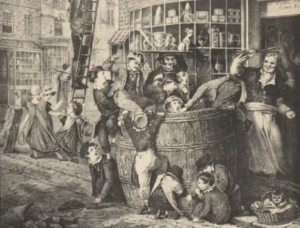
Whether the hero prevails, depends on the book, however, in the picaresque, it does seem that our sympathies drive the writer to create a positive conclusion for the hero. It depends on the novel, BTW, whether they “get it” or not. Sometimes, like in Candide, they do: Candide finishes by learning “we must tend our garden.” Sometimes, like in Huck Finn, you don’t see that at all, and the hero goes back to living in a sugar hogshead barrel.
It’s two a.m. Saturday morning as I write this. I think of the Grateful Dead. “And if you go, no one can follow, that path is for your steps alone.”
Perico
The picaresque novel I remember the most is one called Perico (“Parrot”) that I read in Spanish. It’s a Mexican novel about a well meaning colonial ne’er do well that grows up, the son of a respectable man, and is educated adequately, and upon adulthood turns out to be unbelievably lazy and tries every profession known to man from doctor to cook to barber and finally, at the end, to brigand. In final guise he narrowly escapes being killed.
Perico is the name given him because he wore, as a young man, a green coat that was unusual and looked, from a distance, like the feathers of a macaw. This reminds me that in youth we have additional energy and beauty that does not last for life’s duration, and things that are possible in youth may not be possible by midlife.
In the end, Perico learns to work an honest trade and is not a failure; in fact, to work an honest trade is the best we everyday mortals (who are not trust fund babies) can hope for. And maybe, somehow, working an honest trade is better than being a trust fund baby.
I read Perico and then a few years before I went to teaching school. Teaching was a trade. It was not the heroism or the writing glory I had hoped for. But it was an honest living, something I hadn’t quite risen to before. And in my own picaresque journey, deciding to teach school was the moment when, like Perico, I gave up on being a brigand and hoping that ex-husbands and academic grants would somehow pay the bills.
I am reminded, in this question of career, of the Desiderata of Max Ehrmann, who wrote
“Keep interested in your own career, however humble; it is a real possession in the changing fortunes of time … Let this not blind you to what virtue there is; many person strive for high ideals; and everywhere life if full of heroism.”
Glory, I suppose, is in short supply, but virtue, now that can increase as much as we want it to. As for heroism? That is the opposite of the picaresque trajectory, and the idea that life is truly full of heroism is an interesting reflection at the end of any real or imagined picaresque novel.


